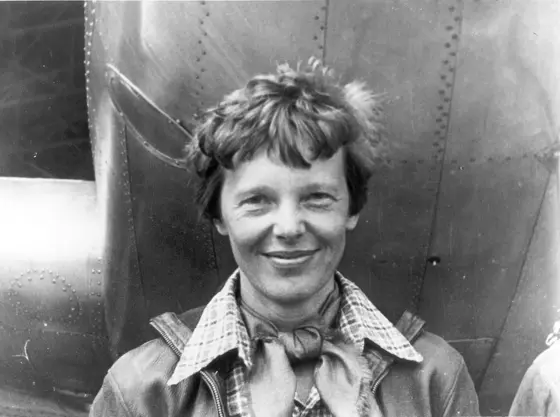
Amelia Earhart's Solo Atlantic Crossing: May 20-21, 1932
Amelia Mary Earhart became the first woman to fly solo and nonstop across the Atlantic Ocean on May 20-21, 1932. She piloted a Lockheed Vega 5B (registration NR7952) from Harbour Grace, Newfoundland, to a farmer's pasture near Culmore, Northern Ireland. The flight covered 2,026 miles in 14 hours and 56 minutes.
Charles Lindbergh had been the first person to complete a solo Atlantic crossing, in May 1927. Earhart was the second person and the first woman, departing from Harbour Grace almost exactly five years after Lindbergh lifted off from Roosevelt Field in New York. Her original destination was Paris. She did not make it.
The 1932 crossing was not Earhart's first time over the Atlantic. She had crossed as a passenger in 1928 aboard the Fokker trimotor Friendship, with pilot Wilmer Stultz at the controls. She was explicit about the difference between those two flights. The 1932 solo was her attempt to close that gap on her own terms.
Earhart Had Already Crossed the Atlantic Once: As a Passenger
In June 1928, Earhart crossed the Atlantic aboard the Fokker F.VIIb/3m trimotor named Friendship, with pilot Wilmer Stultz doing all the flying and mechanic Louis Gordon along for the trip. Sponsorship for the flight came from Amy Phipps Guest, an American socialite who had purchased the aircraft and recruited Earhart for the nominal role of "commander." They departed from Trepassey Bay, Newfoundland, and landed at Burry Port, Wales, on June 17-18, covering roughly 2,000 miles in about 20 hours and 40 minutes.
The reception was extraordinary. A ticker-tape parade in New York. A White House reception. Earhart had not touched the controls. She described herself afterward as "a sack of potatoes." She kept the flight log and held the nominal title of "commander" per her contract, but she privately considered herself a passenger who had received unearned acclaim.
That discomfort stayed with her. The 1932 solo flight was her deliberate correction.
The 1932 Flight: Harbour Grace to a Farmer's Field in Ireland
Earhart prepared the 1932 crossing with Bernt Balchen, the Norwegian polar aviator who had flown with Richard Byrd over the South Pole in 1929. Balchen overhauled the Lockheed Vega 5B and fitted it with extra fuel tanks for the extended range. He registered the aircraft in his own name to keep the press from discovering the attempt before departure. Meteorologist Dr. James Kimball provided weather analysis and identified the departure window.
On May 19, 1932, Earhart, Balchen, and mechanic Eddie Gorski flew from Teterboro Airport in New Jersey to Saint John, New Brunswick, then on to Harbour Grace, Newfoundland. At 7:20 p.m. on May 20, five years to the week after Lindbergh lifted off for Paris, Earhart left Harbour Grace. Her plan was Paris. She did not make it.
Within hours of departure, the problems began accumulating. The altimeter failed. For approximately five hours over the open Atlantic, in darkness, Earhart had no reliable reading of how high she was flying. Ice built up on the wings and sent the aircraft into a spin. She recovered at low altitude by sight alone, pulling up when she could see whitecaps through the dark below her.
A cracked manifold weld produced visible flames along the engine cowling. Earhart could see the fire from the cockpit. She monitored it throughout the remainder of the flight and could do nothing except keep flying and hope the weld held. The fuel gauge leaked. It dripped onto her neck.
As conditions worsened and fuel diminished, Paris was no longer a realistic destination. When she spotted the Irish coastline, she put the Vega down in the first suitable field she could find. That field belonged to Robert Gallagher, near the townland of Culmore, two miles north of Derry, in Northern Ireland.
She climbed out of the cockpit and asked a farmhand, "Where am I?" He replied: "In Gallagher's pasture."
The Lockheed Vega 5B That Made the Crossing Possible
The Lockheed Vega 5B (registration NR7952) was a single-engine high-wing monoplane with a 41-foot wingspan and a 27-foot-6-inch fuselage. It was powered by a Pratt & Whitney Wasp C nine-cylinder radial engine rated at 420 horsepower. Balchen had it modified specifically for the transatlantic crossing with extra fuel tanks to extend range.
The Vega 5B Earhart flew in 1932 was not the aircraft she would fly in 1937. The 1937 circumnavigation attempt used a twin-engine Lockheed Electra 10E, a larger and more technically complex machine with a very different profile and a very different fate. The Vega is the plane that crossed the Atlantic; the Electra is the plane that disappeared.
The Awards That Followed and the Infrastructure Earhart Built for Women Aviators
The recognition came quickly. Earhart received the Distinguished Flying Cross from the United States Congress, presented on July 18, 1932, by Secretary of War Patrick J. Hurley. It was the first Distinguished Flying Cross ever awarded to a woman. She also received the Gold Medal of the National Geographic Society, presented by President Herbert Hoover, the Cross of Knight of the Legion of Honor from the French Government, and the Harmon Trophy (outstanding aviator of the year), which she won twice.
Earhart treated fame as a resource to be spent, not accumulated. She had co-founded The Ninety-Nines in 1929, named for the 99 licensed women pilots who became charter members. She was elected the organization's first president in 1931. As of 2022, the organization has 153 chapters and 27 regional sections worldwide.
Earhart was not the first woman to set an aviation record. Harriet Quimby had earned her pilot's license in 1911 and become the first woman to fly solo across the English Channel in 1912, two decades before Earhart's transatlantic solo. Earhart built on that tradition and used her fame to create infrastructure for the women who came after her.
The Amelia Earhart Fellowship, established by Zonta International in 1938, awards up to $10,000 annually to women pursuing doctoral degrees in aerospace engineering and space sciences. Since its founding, the fellowship has supported 1,335 women from 79 countries through 1,764 fellowships totaling more than $11.9 million.
The Disappearance That Has Never Been Fully Explained
On July 2, 1937, Earhart and her navigator Fred Noonan departed Lae, New Guinea, in a Lockheed Electra 10E bound for Howland Island, a tiny uninhabited atoll in the central Pacific. It was leg 31 of 34 on an equatorial circumnavigation attempt. They had covered roughly 22,000 of the planned 29,000 miles.
The U.S. Coast Guard cutter Itasca was positioned at Howland Island to assist with radio navigation. The radio contact never worked properly. At approximately 8:43 a.m. Howland Island time, the Itasca received Earhart's final confirmed transmission: fuel running low, running north-south along a position line, unable to hear the Itasca on their end. After that, silence.
The U.S. Navy and Coast Guard launched the largest search and rescue operation in history to that point: 16 days, 250,000 square miles. No wreckage, no fuel slick, no survivors. The Navy's conclusion, and still the most widely accepted explanation, is that Earhart and Noonan failed to locate Howland Island, ran out of fuel, and ditched in the ocean. She was declared legally dead on January 5, 1939.
The alternative theory centers on Nikumaroro, a then-uninhabited atoll roughly 400 miles southeast of Howland Island. The International Group for Historic Aircraft Recovery (TIGHAR) has mounted 11 expeditions to the island. Their case rests on bones found in 1940 and a 2018 forensic analysis by Richard Jantz that found the bone proportions more consistent with Earhart's physical profile than 99% of comparative individuals. The bones have never been definitively identified. No aircraft wreckage has been recovered from the site.
Frequently Asked Questions
Who was the first woman to fly solo across the Atlantic Ocean?
Amelia Earhart became the first woman to fly solo and nonstop across the Atlantic on May 20-21, 1932. She piloted a Lockheed Vega 5B from Harbour Grace, Newfoundland, to a pasture near Culmore, Northern Ireland. The flight covered 2,026 miles in 14 hours and 56 minutes.
Why did Amelia Earhart land in Ireland instead of Paris?
In-flight problems forced a change: her altimeter failed, ice built up on the wings, a cracked manifold weld produced visible engine flames, and her fuel gauge leaked. As conditions deteriorated and fuel diminished, she abandoned the Paris destination and put the aircraft down in the first suitable field she could find in Northern Ireland.
Was the 1932 flight Amelia Earhart's first Atlantic crossing?
No. Earhart crossed the Atlantic in June 1928 as a passenger aboard the Fokker Friendship, with pilot Wilmer Stultz doing all the flying. She described herself as "a sack of potatoes" on that trip. The 1932 solo flight was her deliberate effort to cross on her own terms.
What happened to Amelia Earhart's plane after the 1932 flight?
The Lockheed Vega 5B (registration NR7952) is on permanent display at the Smithsonian National Air and Space Museum in Washington, D.C., in the Milestones of Flight gallery alongside the Wright Flyer and the Apollo 11 command module.
What awards did Amelia Earhart receive for the 1932 flight?
Earhart received the Distinguished Flying Cross from Congress (the first ever awarded to a woman), the Gold Medal of the National Geographic Society from President Hoover, the Cross of Knight of the Legion of Honor from France, and the Harmon Trophy.