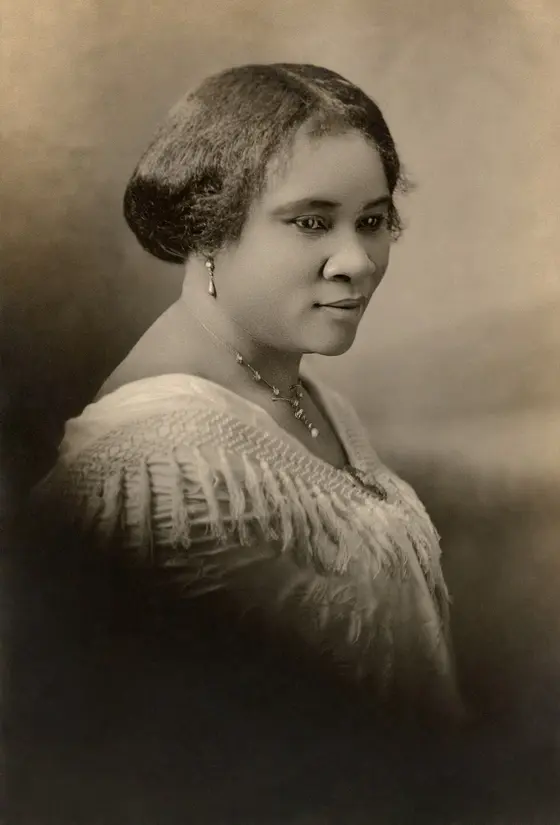
Madam C.J. Walker: From $1.50 to America's First Self-Made Female Millionaire
Madam C.J. Walker, born Sarah Breedlove on December 23, 1867, is recognized by Guinness World Records as the first self-made female millionaire in America. She built her fortune through the Madam C.J. Walker Manufacturing Company, which she founded in 1906 and formally incorporated in Indianapolis in 1911. At her death in May 1919, her estate was valued at more than $1 million, equivalent to between $18 million and $36 million today. Her company employed an estimated 25,000 Walker Agents nationwide and operated 200 beauty schools across the country. She started with approximately $1.50 in her pocket. She was dead at 51.
From Orphan to Entrepreneur: Sarah Breedlove's Early Life
Sarah Breedlove was the first child in her family born into freedom. Her parents, Owen and Minerva Breedlove, had been enslaved on a Delta, Louisiana cotton plantation. She arrived on December 23, 1867, two years after the Civil War ended. By the time she was seven, both parents were dead from illness.
She moved to Vicksburg, Mississippi, to live with her older sister Louvenia and Louvenia's husband. At 14, to escape a difficult household, she married a man named Moses McWilliams. He died in 1887, leaving her a widow at 20 with a two-year-old daughter, A'Lelia.
She moved to St. Louis, where she worked as a laundress for nearly 18 years. By the late 1890s she was losing her hair, a scalp condition widespread among Black women at the time, caused by a combination of poor diet, harsh cleaning agents used in domestic work, and scalp diseases like seborrheic dermatitis that went largely untreated because the American personal care industry produced almost no products formulated for Black women's hair.
In 1905, she moved to Denver, Colorado, with approximately $1.50 to her name. She was 37 years old.
The Product That Started a Revolution: Wonderful Hair Grower
Walker's flagship product was Madam Walker's Wonderful Hair Grower, a scalp conditioning pomade. Its active ingredients included precipitated sulfur, copper sulfate, beeswax, petrolatum, coconut oil, and violet extract to mask the sulfurous smell. The full regimen was sold together as the Walker System.
Walker claimed the formula came to her in a dream. Biographer A'Lelia Bundles, Walker's great-great-granddaughter and the author of the definitive biography "On Her Own Ground" (2001), addresses this directly: the sulfur-and-petrolatum combination had been documented in American medical literature for over a century. The chemistry was not novel.
What Walker genuinely invented was the commercial system built around the product: a branded identity, a structured training curriculum, a licensing framework, a mail-order distribution network, and a marketing approach that positioned her products as a professional hair care regimen rather than a folk remedy. Those were Walker's innovations. The sulfur was already known. The scalable sales and education network was hers.
How Walker Built a Business Empire Before "Franchising" Had a Name
Walker made her money through a direct-sales network at a time when the conventional retail channel was simply not available to her. General merchandise stores did not carry products marketed to Black women. She could not wait for that to change.
Instead, she built a distribution army. Walker trained women as Walker Agents, licensing them to sell the full product line and teach the Walker Method: a complete hair care regimen combining her pomade formula, specific brushing techniques, and the use of a heated pressing comb. Agents worked from their own home shops, earned commissions, and could recruit additional agents into their network.
When Walker relocated to Indianapolis in 1910, she chose the city deliberately: it had multiple railroad lines that made mail-order distribution efficient across the Midwest and South. She built a factory, salon, and training school at 617 Indiana Avenue. Her Indianapolis attorney, Freeman B. Ransom, managed day-to-day company operations from 1910 onward.
Her company charter included a governance clause that would outlast everything else she built: only a woman could serve as company president.
The Lelia College of Beauty Culture, first established in Pittsburgh in 1908, gave Black women professional credentials in the hair care industry. Walker created the first formal certification system for Black beauty workers in America. By the time of Walker's death in 1919, 200 beauty schools were operating under the Walker brand. The Walker Agent network numbered approximately 25,000.
In 1917, Walker organized her agents into the National Beauty Culturists and Benevolent Association and convened the group in Philadelphia. Two hundred women attended. At the close of the convention, the assembled women sent a telegram to President Woodrow Wilson demanding federal anti-lynching legislation. Walker had built a commercial convention and used it to issue a political demand.
The Guinness Record and Why It Is Harder to Verify Than It Sounds
Guinness World Records officially lists Madam C.J. Walker as the "first self-made millionairess" in American history. The record is real. It is also built from reconstruction rather than a bank statement.
Walker denied being a millionaire during her lifetime. The Guinness designation rests on her documented real estate holdings plus the assessed value of her controlling interest in the Madam C.J. Walker Manufacturing Company at the time of her death. Her New York property holdings alone were valued at $700,000 at the time. Total estate value exceeded $1 million.
The record's contestedness is worth understanding honestly. Biographer A'Lelia Bundles acknowledges that Annie Turnbo Malone, Biddy Mason, and Mary Ellen Pleasant may have reached comparable personal wealth. Walker holds the Guinness record because her finances are the best documented, not necessarily because the others did not achieve it.
Villa Lewaro and What Walker Did with Her Money
Her most visible statement of accumulated wealth was Villa Lewaro, a 34-room mansion in Irvington-on-Hudson, New York. She commissioned it in 1917; construction was completed in 1918. The architect was Vertner Woodson Tandy, the first licensed Black architect in New York State. Construction cost $250,000, roughly $4.5 million in today's dollars. The name "Lewaro" was coined by the opera singer Enrico Caruso, assembled from the first two letters of each part of A'Lelia Walker Robinson's name.
Walker did not intend Villa Lewaro as a private retreat. She described it as a statement: proof that Black women could build and hold lasting wealth. She used it as a gathering place for community leaders, civil rights organizers, and cultural figures of the Harlem Renaissance.
Her will directed that two-thirds of future net profits from the company go to charitable causes. Her documented philanthropic commitments included a $5,000 pledge to the NAACP's anti-lynching campaign fund (the largest individual gift the NAACP had received at that point), scholarships for women at Tuskegee Institute, and support for homes for elderly Black Americans.
Walker died at Villa Lewaro on May 25, 1919, of hypertension and kidney failure. Both Villa Lewaro and the Madam Walker Theatre Centre in Indianapolis are listed on the National Register of Historic Places.
Frequently Asked Questions
Was Madam C.J. Walker really the first self-made woman millionaire in America?
Guinness World Records lists her as the first self-made millionairess in American history, based on her documented estate at death, valued above $1 million in 1919. Biographer A'Lelia Bundles notes that other women, including Annie Turnbo Malone and Biddy Mason, may have reached comparable wealth, but Walker's finances are the best documented. Walker herself denied being a millionaire during her lifetime.
Did Madam C.J. Walker invent the hot comb?
No. The heated pressing comb existed before Walker. What she developed was the Walker Method: a complete hair care regimen combining her Wonderful Hair Grower pomade formula, specific brushing techniques, and the heated comb in a standardized, teachable system. Her innovation was the method, the brand, and the training network, not any individual tool.
How accurate is the Netflix series "Self Made"?
The 2020 Netflix miniseries takes significant creative liberties with the historical record. A'Lelia Bundles, Walker's great-great-granddaughter and the definitive biographer, has publicly noted inaccuracies, particularly in how Annie Turnbo Malone is portrayed. The biography "On Her Own Ground" (2001) is the most reliable account of Walker's life.
How much is Madam C.J. Walker worth in today's money?
At her death in May 1919, her estate was valued at more than $1 million, with New York property holdings alone valued at $700,000. In today's dollars, that estate is estimated at between $18 million and $36 million, depending on the inflation measure used.
Who else might have been the first self-made woman millionaire?
Historians identify Annie Turnbo Malone, Biddy Mason, and Mary Ellen Pleasant as women who may have reached comparable wealth before their finances can be fully verified. Walker holds the Guinness World Records designation because her estate documentation is the most complete of the group.