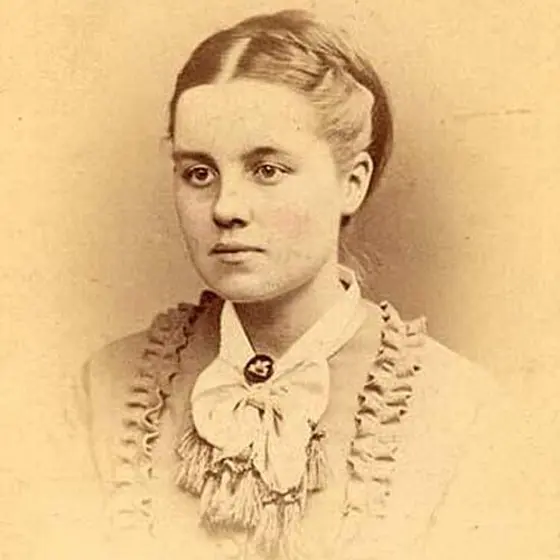
Helen Magill White was the first woman to earn a doctoral degree in the United States. Boston University awarded her a Ph.D. in Greek on February 28, 1877. Her dissertation was titled "The Greek Drama." Boston University had opened all its departments to women in 1867, making it the only American institution positioned to grant a woman a research doctorate at that time. No earlier female American PhD has been documented. The record has not been revised.
Helen was born November 28, 1853, in Providence, Rhode Island, and died October 28, 1944, at age 90. She completed her undergraduate degree at Swarthmore College in 1873, enrolled in Boston University's graduate program, and received her doctorate four years later. The degree was in classical studies, specifically Greek drama, within the classical philology tradition then dominant in elite humanities scholarship. The dissertation was believed lost for over 140 years before its rediscovery at Cornell University Library in 2018.
The Quick Answer: Helen Magill White, Boston University, February 28, 1877
Boston University conferred Helen Magill White's Ph.D. in Greek on February 28, 1877, through its College of Arts and Science. She was 23 years old.
The degree was a research doctorate, not an honorary one. Boston University applied a single standard to male and female candidates: the same dissertation requirements, the same faculty evaluation, the same command of classical Greek. That single standard was itself a notable institutional position in the 1870s.
One element of the story remained missing until recently: the dissertation itself. "The Greek Drama" was believed lost for over 140 years. In 2018, researchers found the document in the Rare Book and Manuscript Collections at Cornell University Library. The first page is now partially viewable through Cornell's digital archive (digital.library.cornell.edu/catalog/ss:8329854). The rediscovery gave a document that had only existed in records an actual physical presence.
The Quaker Family That Made Education Non-Negotiable: Edward Hicks Magill and Swarthmore College
Helen Magill White was born in 1853 into a household that did not treat women's education as a question. Her father, Edward Hicks Magill, was a Quaker educator who would become the second president of Swarthmore College. He had already decided the answer before Helen could ask it. All five of his daughters were raised to become college teachers. That expectation, ordinary in the Magill household and nearly nowhere else, is where the story of the first female American doctorate actually begins.
The Magill family moved to Boston in 1859. Helen enrolled as the only female student at Boston Public Latin School, a rigorous classical preparatory institution. The Latin School's curriculum gave her the Greek and Latin foundations that would shape her doctoral work. When Edward Hicks Magill joined the faculty of the newly founded Swarthmore College in 1869, Helen enrolled there as well, graduating as one of five women, and one man, in Swarthmore's first graduating class in 1873.
This was Quaker egalitarianism made concrete. The doctrine of the Religious Society of Friends holds that all people carry an equal inner light, a principle that had long positioned Quaker communities toward gender equality in worship and in practical life. For the Magill household, that doctrine translated into an educational program: the daughters would be educated as seriously as any man's sons.
Helen Magill White was not the first woman to earn a college degree in the United States. Catherine Brewer Benson had earned a bachelor's degree from Georgia Female College in 1840, nearly four decades earlier. But a doctoral degree was a different category of achievement entirely. The first woman to earn a college degree in the United States had entered an institution built for women; Helen Magill White entered a graduate program that had previously existed only for men.
How Boston University's 1867 Coeducation Policy Made the Milestone Possible
The milestone of February 28, 1877 required an institution willing to follow through. Boston University was that institution, and its role was not incidental.
Boston University admitted women to all departments beginning in 1867. At the time, the dominant model for American graduate education was the German research university. Institutions such as the University of Berlin and the University of Heidelberg had never admitted women to doctoral programs. The German model valued original scholarship, laboratory research, and rigorous examination, but it applied those standards only to men. American universities that organized their graduate programs along German lines inherited that exclusion as a structural feature, not a formal policy.
Boston University's governance made a different decision. In 1873, BU merged with the New England Female Medical College, becoming the first accredited coeducational medical school in the country. These were principled institutional commitments, applied across the university's departments.
Helen enrolled in Boston University's graduate program after completing her degree at Swarthmore and studied Greek. The Ph.D. was conferred on February 28, 1877. Without Boston University's 1867 policy decision, the milestone shifts to a different year and a different woman. Helen's achievement and BU's institutional commitment are not separable.
The Dissertation: "The Greek Drama," Classical Philology, and Its 140-Year Disappearance
Helen's dissertation "The Greek Drama" sat within the classical philology tradition that defined elite humanities scholarship in the 1870s. Classical philology demanded command of ancient Greek, close engagement with primary texts, original argumentation, and familiarity with the emerging scholarly literature on Athenian theater. Boston University applied those standards equally to male and female candidates.
The dissertation's subject was not a peripheral topic in the discipline. Athenian tragedy and comedy were central to the philological project of the 19th century. Scholars across Europe were producing major studies of Aeschylus, Sophocles, Euripides, and Aristophanes. Helen was entering a live scholarly conversation, not a footnote.
Then the dissertation disappeared. Or rather, it was not actively sought.
For more than a century, the dissertation existed only as a title in degree records. In 2018, researchers found the document in Helen's personal papers, held at Cornell's Rare Book and Manuscript Collections. The finding aid for her papers is accessible through Cornell's archival catalog (rmc.library.cornell.edu/EAD/htmldocs/RMM04107.html). The first page of the dissertation is digitized and publicly available. Detailed scholarly analysis of the text's full contents has not yet been widely published, but the document itself is no longer lost.
There is a particular irony in where it turned up. Cornell University was the institution founded by Andrew Dickson White. Helen married Andrew Dickson White in 1890. Her dissertation spent over a century in the archive of the university her future husband had built.
A PhD That Could Not Open Doors It Should Have Opened: Career Barriers in the 1880s
The credential existed. The institutional pathways did not.
After earning her doctorate from Boston University, Helen served as principal of a private school in Johnstown, Pennsylvania. In 1883, the educator Edward Everett Hale selected her to organize Howard Collegiate Institute in West Bridgewater, Massachusetts. Howard Collegiate Institute was a non-sectarian women's school of approximately 40 students. Helen held real institutional authority there: she could hire faculty and conduct college-level courses. It was the closest she came to the academic career her doctoral training pointed toward.
Helen left Howard Collegiate Institute in 1887, partly because of a dispute with trustees over a sewerage infrastructure campaign she had championed. The disagreement was practical, not philosophical, but it ended her tenure.
In the early 1880s, she had pursued advanced study at Newnham College, Cambridge. The Cambridge tripos examinations were the most rigorous honors examinations in the English-speaking world. Helen sat the tripos in 1881. An illness during the examination period produced a third-class result. At Cambridge, a third-class tripos result carried significant consequences for scholarly reputation and subsequent career prospects. The examination system offered no accommodation for illness. A third-class tripos result followed a candidate.
One detail about Cambridge deserves its own sentence: the University of Cambridge did not award degrees to women until 1948. Seventy-one years after Helen received her American doctorate from Boston University, Cambridge was still declining to formally credential women it educated. A woman could study there, sit the examinations, and still not receive the degree.
Helen subsequently taught at Evelyn College for Women, the women's annex to Princeton University, and taught physical geography at a Brooklyn high school during a period of illness. She held the nation's first female Ph.D. and spent much of the following decade teaching secondary school. The broader academic system had no established structures for women with research degrees. There were no faculty positions waiting, no research fellowships available, no institutional roles designed to use what Helen had earned.
The gap between credential and career was not unique to academic women. In law, the first woman admitted to the bar faced parallel institutional resistance in the same decade. The pattern was consistent: women in the 1870s and 1880s could obtain the credential and still find the profession closed.
In 1887, Helen was presenting a paper about her Newnham College experience at the American Social Science Association when she met Andrew Dickson White. White was the founding president of Cornell University and a college classmate of her father's. They married in September 1890. The marriage brought social standing within elite academic circles. It also shifted how the public record understood her. Three children followed; two died in childhood. Andrew Dickson White died in 1918. Helen outlived him by nearly four decades, dying on October 28, 1944, at age 90.
From One Doctorate to a Majority: Title IX, the NSF Survey of Earned Doctorates, and the 142-Year Arc
Helen Magill White's 1877 doctorate stands at the beginning of a 150-year arc. The progress that followed was slow.
Title IX of the Education Amendments of 1972 prohibited sex discrimination at institutions receiving federal funding. Title IX accelerated the trend; it did not originate it. Women had been earning doctoral degrees since 1877. The pace simply remained slow until the legal barriers were removed.
The NSF Survey of Earned Doctorates tracks doctoral degree attainment annually. By 2009, women had crossed the threshold that Helen had been the only one to cross in 1877. Since 2009, women have earned a majority of doctoral degrees among U.S. citizens and permanent residents every single year. In 2023, that figure was 53.1%.
The distribution across academic fields tells a more complicated story. Women earn 74.7% of psychology doctorates, 73.2% in education, and 66.9% in health sciences. In engineering, the figure is 26.5%. In mathematics and statistics, 27.5%. In the physical sciences, 33.8%. The overall majority does not reflect uniform access across every discipline. Helen's field, classical studies, sits within the broader humanities category where women have been proportionally well-represented for decades. The fields with the sharpest remaining gender gaps are those with the most direct pipelines into high-paying industries.
The gap between an institution that said yes in 1867 and a national majority in 2009 is 142 years. The gap between one doctoral degree and a majority is a generation of legal change, institutional expansion, and individual decisions made by millions of women who came after Helen Magill White did it first.
Frequently Asked Questions
Who was the first woman to earn a PhD in the United States?
Helen Magill White, born November 28, 1853, in Providence, Rhode Island, was the first woman to earn a doctoral degree in the United States. Boston University awarded her a Ph.D. in Greek on February 28, 1877. The record has not been revised; she remains the documented first.
What university awarded the first PhD to a woman?
Boston University was the first American university to award a Ph.D. to a woman. The institution had committed to admitting women to all departments in 1867, a full decade before Helen Magill White completed her doctorate. That coeducation policy was what made her milestone possible.
What was Helen Magill White's dissertation about?
Her dissertation, titled "The Greek Drama," focused on ancient Greek theater within the classical philology tradition. The work required command of ancient Greek, textual analysis, and engagement with emerging scholarly literature on Athenian drama. Believed lost for over a century, the dissertation was rediscovered in 2018 at Cornell University Library's Rare Book and Manuscript Collections.
When did women start earning more PhDs than men in the United States?
Women first earned a majority of doctoral degrees among U.S. citizens and permanent residents in 2009, according to the NSF Survey of Earned Doctorates. The trend has continued every year since. By 2023, women earned 53.1% of research doctorates among U.S. citizens and permanent residents. In 1970, that figure was only 14%.
Did Helen Magill White become a professor after earning her PhD?
She did not hold a sustained university faculty position. After her doctorate from Boston University, she served as a school principal, organized Howard Collegiate Institute in Massachusetts, studied at Newnham College, Cambridge (where women could not earn degrees), and spent periods teaching secondary school. The institutional pathways for women with research credentials were severely limited in the 1880s and 1890s. She married Andrew Dickson White, founding president of Cornell University, in 1890 and died in 1944 at age 90.