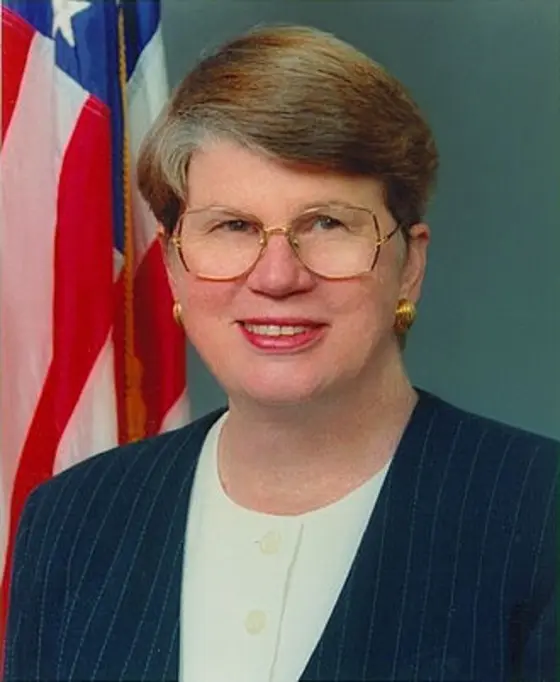
Janet Reno's Confirmation as the 78th Attorney General of the United States
On March 12, 1993, the United States Senate confirmed Janet Reno as the 78th Attorney General of the United States by a vote of 98 to 0. She was 54 years old. She was President Bill Clinton's third choice for the position, after his first two nominees withdrew in what the press dubbed "Nannygate." She turned out to be the one who lasted.
Reno served for nearly eight years, from March 1993 to January 2001, making her the longest-serving Attorney General of the twentieth century. Her tenure encompassed some of the most consequential and controversial law enforcement decisions in modern American history: Waco, the Oklahoma City bombing prosecution, the Microsoft antitrust lawsuit, and the Elian Gonzalez case.
Reno's Path from Miami-Dade State Attorney to the Justice Department
Reno was born on July 21, 1938, in Miami, Florida. Her father, Henry Reno, was a police reporter for the Miami Herald for 43 years. Her mother, Jane Wood Reno, was an investigative journalist for the Miami News who built the family's house largely by hand in the South Florida scrubland near the edge of the Everglades. Reno grew up in that house and returned to it throughout her life.
She attended Cornell University, then enrolled at Harvard Law School, graduating in 1963 as one of 16 women in a class of more than 500. She returned to Florida, worked in private practice and as a staff attorney for the Florida House of Representatives, and was appointed State Attorney for Dade County in 1978 after the incumbent resigned. She won election to the office five times, serving as Miami-Dade County's top prosecutor for 15 years before Clinton nominated her for the nation's top law enforcement post.
In Miami, Reno developed a national reputation for two areas of prosecutorial innovation: juvenile justice diversion programs, which redirected nonviolent young offenders away from incarceration and toward education and rehabilitation, and child abuse prosecution, which required her office to develop specialized investigative techniques for cases involving young victims. Both programs became models for jurisdictions across the country.
The Nannygate Controversy and Why Reno Became Clinton's Third Choice
Reno was not Clinton's first choice, or his second. His initial nominee, corporate attorney Zoe Baird, withdrew in January 1993 after it emerged that she had employed undocumented immigrants as household workers and failed to pay their Social Security taxes. His second nominee, federal judge Kimba Wood, withdrew weeks later over a similar issue. The pattern of withdrawals, centered on domestic employment arrangements, became known collectively as "Nannygate."
Clinton turned to Reno, then largely unknown outside Florida. She had no such controversy in her background and had spent her career as a public sector prosecutor rather than in corporate law. Her 98-0 Senate confirmation vote reflected that clean record.
The Waco Siege: Reno's Decision and Its Consequences
Six weeks into her tenure, Reno confronted the most consequential decision of her early months in office. The FBI had been in a 51-day standoff with the Branch Davidians, a religious group led by David Koresh, at their Mount Carmel Center compound near Waco, Texas. Federal agents from the Bureau of Alcohol, Tobacco, Firearms and Explosives had attempted to serve search and arrest warrants on February 28, 1993, and a gunfight left four ATF agents and six Branch Davidians dead.
On April 19, 1993, Reno authorized the FBI to deploy CS gas to end the standoff. A fire broke out inside the compound. Seventy-six Branch Davidians died, including David Koresh and 25 children. Whether the fire was started by members of the group or triggered by the FBI's actions remained disputed for years and was the subject of multiple congressional investigations and a federal review by former Senator John Danforth.
Reno took full public responsibility before Congress and before the country. "I made the decision. I'm accountable. The buck stops with me," she told reporters in April 1993. That willingness to accept accountability rather than deflect it was unusual in Washington and became one of the defining characteristics of her public reputation.
Major Cases During Reno's Tenure as Attorney General
Reno's Justice Department prosecuted Timothy McVeigh and Terry Nichols for the bombing of the Alfred P. Murrah Federal Building in Oklahoma City on April 19, 1995, which killed 168 people and injured hundreds more. McVeigh was convicted in 1997, sentenced to death, and executed by lethal injection in June 2001. Nichols was convicted of conspiracy and involuntary manslaughter and sentenced to life in prison without parole.
In 1998, the Justice Department under Reno filed a landmark antitrust lawsuit against Microsoft Corporation, arguing that Microsoft had used its Windows operating system monopoly to illegally crush competition from Netscape Navigator and other browser competitors. US District Judge Thomas Penfield Jackson ruled in 2000 that Microsoft had violated the Sherman Antitrust Act. A federal appeals court later reversed the breakup remedy but upheld the finding that Microsoft had illegally maintained its monopoly.
In April 2000, Reno ordered federal agents from the Immigration and Naturalization Service to seize six-year-old Elian Gonzalez from the Miami home of his paternal relatives and return him to his father in Cuba. Gonzalez had survived a crossing of the Florida Straits in November 1999 after his mother drowned. A news photograph showing a helmeted INS agent pointing a weapon near the terrified boy became one of the most reproduced and debated images of the decade. A federal appeals court upheld the return, and Gonzalez was reunited with his father in Cuba in June 2000.
Reno's Later Life: Parkinson's Disease, the Florida Governor's Race, and Her Death
Reno was diagnosed with Parkinson's disease in November 1995, roughly two and a half years into her first term as Attorney General. She disclosed the diagnosis publicly and continued to serve for nearly six more years, completing two full terms under Clinton. The tremors from Parkinson's became increasingly visible in her later years in office, but she did not step down.
After leaving the Justice Department in January 2001, she returned to Florida and ran for governor in the 2002 Democratic primary. She lost to Bill McBride, who went on to lose the general election to incumbent Governor Jeb Bush.
She died on November 7, 2016, at her home in Miami, the house her mother had built. She was 78 years old. The cause of death was complications from Parkinson's disease. She had lived with the condition for 21 years. The Justice Department's headquarters, the Robert F. Kennedy Department of Justice Building in Washington, D.C., flew its flags at half-staff following her death.
Frequently Asked Questions
Who was the first woman Attorney General?
Janet Reno, confirmed as the 78th Attorney General of the United States on March 12, 1993, by a Senate vote of 98 to 0.
How long did Janet Reno serve as Attorney General?
Nearly 8 years, from March 1993 to January 2001, making her the longest-serving Attorney General of the twentieth century.
Was Janet Reno President Clinton's first choice?
No. She was his third choice. His first nominee, Zoe Baird, and his second, Kimba Wood, both withdrew after controversies involving undocumented household employees, a series of events the press called "Nannygate."
What major events occurred during Reno's tenure?
The Waco siege and fire (April 1993), the prosecution of Oklahoma City bombers Timothy McVeigh and Terry Nichols (1995), the Microsoft antitrust lawsuit (1998), and the Elian Gonzalez case (2000).
What did Janet Reno do before becoming Attorney General?
Reno attended Cornell University and Harvard Law School, graduating in 1963. She served as State Attorney for Dade County, Florida, from 1978 to 1993, winning election five times and building a national reputation for juvenile justice reform.
How many women have served as Attorney General?
Three, as of 2024: Janet Reno (1993-2001), Loretta Lynch (2015-2017), and Sally Yates, who served as acting Attorney General for ten days in January 2017 before being dismissed by President Trump.
What was Reno's decision at Waco?
On April 19, 1993, six weeks after taking office, Reno authorized the FBI to use CS gas to end a 51-day standoff with the Branch Davidians at their compound near Waco, Texas. A fire broke out and 76 people died. Reno publicly accepted full responsibility for the decision.