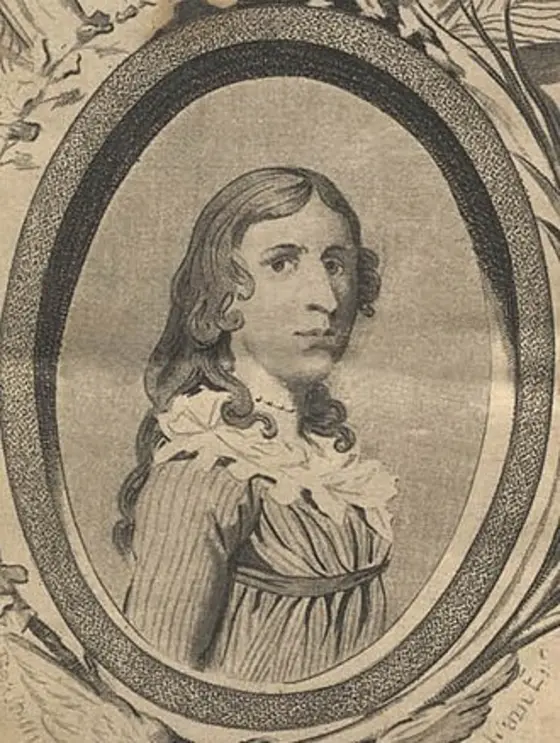
How Deborah Sampson Became the First Woman to Serve in the Continental Army
In May 1782, Deborah Sampson enlisted in the Continental Army's 4th Massachusetts Regiment under the alias "Robert Shurtliff," becoming the first documented woman to serve in the United States military. She was 21 years old, stood 5 feet 7 inches tall (exceptionally tall for a woman of the 1780s), and bound her chest with strips of cloth to pass the enlistment inspection. No recruiter questioned her. She served in a light infantry company for more than a year, participated in armed engagements, sustained two combat wounds, and was honorably discharged at West Point on October 25, 1783, by order of General Henry Knox.
Her identity was not exposed by a fellow soldier. A Philadelphia physician named Dr. Barnabas Binney discovered she was a woman while treating her for a high fever in 1783. Even then, she was not court-martialed. General Knox issued an honorable discharge, and she returned to Massachusetts with her service officially recognized.
Early Life: Indentured Service and Self-Education in Colonial Massachusetts
Sampson was born on December 17, 1760, in Plympton, Massachusetts, to a family that traced its ancestry to Mayflower passengers John Alden and Priscilla Mullins. Her father, Jonathan Sampson, abandoned the family when she was young. Her mother, Deborah Bradford Sampson, was unable to support all seven children, and placed Deborah as an indentured servant at age 10 in the household of the Thomas family of Middleborough, Massachusetts, where she remained until age 18.
She received no formal schooling during her indenture. She taught herself to read and write using the Thomas children's textbooks, later working briefly as a schoolteacher and textile weaver. Her physical strength was noted by contemporaries. By her own later account, she was restless and drawn to military service from an early age.
Her first enlistment attempt, in early 1782, failed when a neighbor recognized her at a Bellingham tavern and reported her to local authorities. Her Baptist congregation briefly excommunicated her for "dressing in men's clothes and behaving in an unseemly manner." She moved to a different town and tried again. This time, she succeeded.
Military Service in the 4th Massachusetts Regiment's Light Infantry Company
Sampson served in a light infantry company, an elite tactical unit assigned to scouting, skirmishing, and rapid-assault operations rather than standing-line combat. Light infantry soldiers were selected for speed, stamina, and individual initiative. Assigned to the garrison area around New York City, her regiment held the lines separating Patriot-controlled territory from British-occupied Manhattan in the Revolutionary War's final phase.
She participated in multiple engagements in the lower Hudson Valley region. At the Battle of Tarrytown in June or July 1782, she received a saber cut to the forehead and a musket ball wound to the left thigh. Fellow soldiers in her company recorded no suspicion of her identity. Her height, physical endurance, and habit of keeping to herself reinforced her cover.
In the summer of 1783, Sampson contracted a severe fever, possibly typhus or malignant fever, during an epidemic sweeping through Philadelphia. Dr. Barnabas Binney, a prominent Philadelphia physician, examined her at the hospital and discovered she was a woman. He kept her secret initially, moving her to his private home on Chestnut Street to recover. He eventually notified her commanding officer, Captain George Webb, who passed word up the chain to General Knox.
She was not charged with any offense. Knox issued her an honorable discharge, and the Army returned her to Massachusetts with her service record intact.
Pension, Public Recognition, and Legacy After the Revolutionary War
In 1785, Sampson married Benjamin Gannett, a farmer from Sharon, Massachusetts. They had three biological children and adopted a fourth. The family lived in chronic financial difficulty for the rest of her life.
In 1792, the Massachusetts General Court awarded her a pension of 34 pounds, citing formal findings that she "did actually perform the duty of a soldier in the late army of the United States." In 1802, she became one of the first American women to deliver paid public lectures, touring Massachusetts, New York, and Rhode Island to describe her military service, sometimes appearing in uniform.
Paul Revere, who lived near the Gannetts in the Boston area and knew Sampson personally, wrote a formal letter to Congress on her behalf in 1804. His letter described her as "much more deserving than hundreds to whom Congress have been generous." In 1805, Congress placed her on the federal military pension rolls at $4 per month, the standard rate for disabled Revolutionary War veterans.
Sampson died on April 29, 1827, in Sharon, Massachusetts, at age 66. In 1838, eleven years after her death, Congress passed a special act granting a pension to her surviving heirs. In 1983, the Commonwealth of Massachusetts designated her the official state heroine, acknowledging her singular role in American military history.
Frequently Asked Questions
Who was the first woman to serve in the US military?
Deborah Sampson, who enlisted in the Continental Army's 4th Massachusetts Regiment in 1782 under the alias "Robert Shurtliff" and served as a light infantry soldier for more than a year.
How was Deborah Sampson discovered?
Dr. Barnabas Binney, a Philadelphia physician, discovered she was a woman while treating her for a severe fever in 1783. He notified her commanding officer after she recovered; she was honorably discharged rather than punished.
When were women officially allowed in the US military?
The Army Nurse Corps (1901) created the first permanent female military role. Full permanent integration came with the Women's Armed Services Integration Act of 1948, which allowed women to serve in all military branches in a non-auxiliary capacity.
Did Deborah Sampson receive a military pension?
Yes. The Massachusetts legislature awarded her a state pension in 1792. In 1805, with lobbying by Paul Revere, Congress placed her on the federal pension rolls at $4 per month.
When were women allowed in combat roles?
The Department of Defense lifted the combat exclusion policy in 2013. By January 2016, all combat positions, including infantry, armor, and special operations forces, were opened to women.