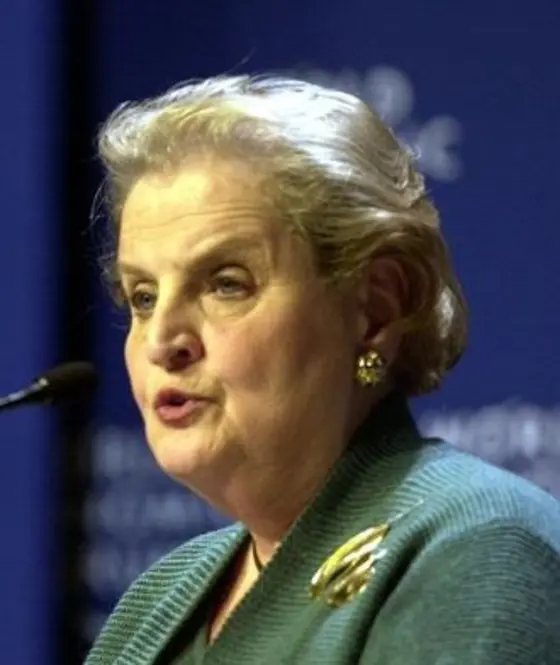
Madeleine Albright's Confirmation as the 64th Secretary of State
Madeleine Korbel Albright became the first woman to serve as U.S. Secretary of State on January 23, 1997. She was the 64th Secretary of State, appointed by President Bill Clinton and confirmed by the U.S. Senate on January 22, 1997, by a vote of 99-0. Albright served through January 20, 2001, completing the full four years of Clinton's second presidential term. At the moment of her confirmation, she held the highest-ranking position ever occupied by a woman in U.S. government history.
Albright was born Marie Jana Korbelova in Prague, Czechoslovakia, on May 15, 1937. She became an American citizen in 1957 at age 20. The distance between those two facts, a Czech refugee becoming America's chief diplomat, is the story worth understanding.
Albright died on March 23, 2022, in Washington, D.C., at age 84. Three women have served as U.S. Secretary of State: Albright (1997-2001), Condoleezza Rice (2005-2009), and Hillary Clinton (2009-2013). Of the 71 people who have held the office in U.S. history, those three are the only women.
Three Escapes: The Refugee Who Became America's Top Diplomat
Josef Korbel, Albright's father, was a Czech diplomat who had lived through totalitarianism twice before his daughter was old enough to understand it. Korbel fled Czechoslovakia in 1939 when the Nazi occupation made the family's position untenable, relocating to London. He fled again in 1948 when the Communist coup eliminated any prospect of their return to Prague. Both times he took his family with him.
The family settled in Denver, Colorado, after the second escape. Josef Korbel joined the faculty at the University of Denver and eventually became a professor of international politics. Madeleine Albright became a U.S. citizen in 1957, at age 20.
Josef Korbel's central conviction, forged from direct experience with both Nazi occupation and Soviet-backed authoritarianism, was that democratic societies cannot remain passive when confronted with authoritarian aggression. That conviction became Madeleine Albright's foundational foreign policy framework.
Albright's parents raised her Catholic. They had converted from Judaism to Catholicism in 1941 during the Nazi occupation of Czechoslovakia, and never disclosed that conversion to their children. In early 1997, three weeks after her confirmation as Secretary of State, the Washington Post reported what her parents had withheld: both had been born into Jewish families. Three of her grandparents had died in Nazi death camps. The total number of relatives killed was approximately 26.
The Path to the Cabinet: Georgetown, the UN, and a 99-0 Vote
Albright graduated from Wellesley College in 1959 on a full scholarship, earning a degree in political science. Her doctorate came from Columbia University in 1975. Her doctoral dissertation examined the role of journalists during the Prague Spring of 1968.
Albright's entry into government came through Senator Edmund Muskie's Senate staff, where she worked from 1976 to 1978. She then joined the National Security Council under Zbigniew Brzezinski during the Carter administration. When Ronald Reagan won the presidency in 1980, Albright moved to Georgetown University, where she taught Eastern European Studies and directed the university's program on women in global politics at the Walsh School of Foreign Service.
President Clinton appointed Albright U.S. Ambassador to the United Nations in 1993. The four years she spent at the UN established her as the Clinton administration's most consistent advocate for military action in the Balkans. When Warren Christopher left the Secretary of State position at the end of Clinton's first term, Clinton nominated Albright as his successor. The Senate confirmed Albright 99-0.
What Albright Actually Did as Secretary of State
The most consequential decision of Albright's tenure was also the most contested. By 1998, Slobodan Milosevic's government was conducting a systematic military campaign against ethnic Albanians in the Serbian province of Kosovo. Albright pushed the Clinton administration to respond with force.
In March 1999, NATO launched an air campaign against Serb-led Yugoslavia that lasted 78 days. The operation proceeded without United Nations Security Council authorization. The campaign ended with Milosevic's withdrawal from Kosovo and the protection of hundreds of thousands of Kosovo Albanians from further violence.
Albright had been building the evidentiary record for years. As U.S. Ambassador to the United Nations in 1995, Albright presented to the Security Council the first photographic evidence of mass atrocities at Srebrenica, establishing the factual foundation that led to the International Criminal Tribunal for the former Yugoslavia.
A statue of Albright stands in Pristina, Kosovo's capital. Streets in Kosovo and Albania carry her name. The former Serbian government declared Albright persona non grata in 2021. The statue and the declaration together are the clearest summary of her contested legacy abroad.
Poland, Hungary, and the Czech Republic joined NATO in 1999, becoming the first former Warsaw Pact members admitted to the alliance. Albright was the chief architect of that expansion. For Albright, the decision carried personal weight: her family had been displaced twice by authoritarian powers that had dominated Central Europe.
The Women Who Came After Her
Three women have served as U.S. Secretary of State. That is the complete list, across 71 people and more than two centuries of the office's existence.
Condoleezza Rice was the second woman to hold the position (2005-2009) and the first African-American woman to serve as Secretary of State. Rice was appointed by President George W. Bush and succeeded Colin Powell.
Hillary Clinton was the third woman Secretary of State (2009-2013), appointed by President Barack Obama. At Albright's funeral in April 2022, Clinton revealed that she had personally urged Bill Clinton to nominate Albright as the first female Secretary of State in 1996.
The same decade that produced Albright's appointment also produced the first woman Attorney General in 1993. That arc reached the executive branch itself when the first woman Vice President took office in January 2021.
Frequently Asked Questions
Who was the first woman to serve as U.S. Secretary of State?
Madeleine Albright was the first woman to serve as U.S. Secretary of State. She was confirmed by the Senate 99-0 on January 22, 1997, and sworn in the following day. She served through January 20, 2001.
How many women have been Secretary of State?
Three women have served as U.S. Secretary of State out of 71 total people to hold the office: Madeleine Albright (1997-2001), Condoleezza Rice (2005-2009), and Hillary Clinton (2009-2013).
Was Madeleine Albright born in the United States?
No. Albright was born Marie Jana Korbelova in Prague, Czechoslovakia, on May 15, 1937. Her family fled Nazi occupation in 1939 and later fled the 1948 Communist coup. She became a U.S. citizen in 1957 at age 20.
What did Madeleine Albright do during the Kosovo conflict?
As Secretary of State, Albright was the Clinton administration's strongest advocate for using NATO military force to halt Slobodan Milosevic's campaign against Kosovo Albanians. The resulting 78-day NATO bombing campaign in 1999 stopped the military crackdown. A statue of Albright stands in Pristina, Kosovo's capital.
Did Madeleine Albright know she was Jewish?
Albright did not know until age 59. In early 1997, just as she was beginning her tenure as Secretary of State, the Washington Post reported that her parents had been born into Jewish families and had converted to Catholicism in 1941 without ever telling their children. Approximately 26 relatives had been killed in Nazi death camps.