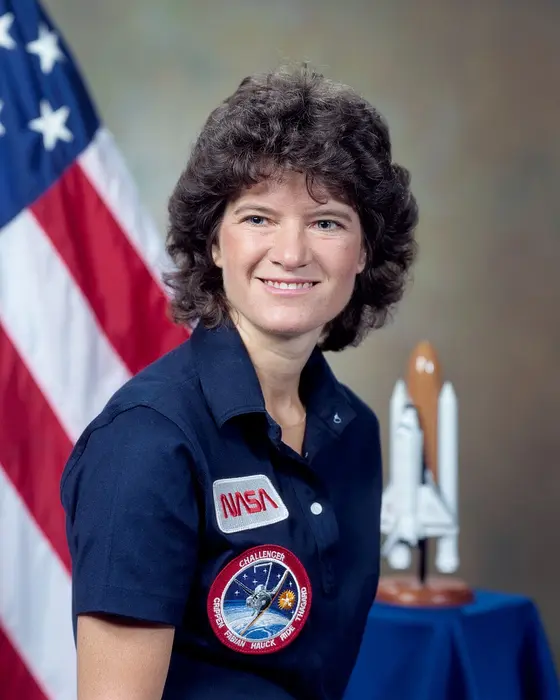
Sally Ride Becomes the First American Woman in Space: June 18, 1983
Sally Ride flew to space on June 18, 1983, becoming the first American woman to reach orbit, twenty years after the Soviet Union had already done it. She was 32 years old, a Stanford physicist who had spotted a NASA want ad in a campus newspaper six years earlier and applied without much fanfare. Her mission, STS-7 aboard Space Shuttle Challenger, lasted six days, completed 135 orbits, and accomplished genuine technical work that had nothing to do with symbolism.
Ride was not the first woman in space. Soviet cosmonaut Valentina Tereshkova reached orbit in June 1963. Svetlana Savitskaya, also Soviet, flew in 1982. By the count, Ride was the third woman in space globally, and the first American. That qualifier matters. The twenty-year gap between Tereshkova and Ride was not accidental.
Her full name was Sally Kristen Ride. She was born May 26, 1951, in Encino, California. She died July 23, 2012, from pancreatic cancer, at 61. Between those dates: two spaceflights, two disaster investigations, a physics professorship at UC San Diego, an education organization that reached 6 million students, and a private life that became part of the historical record only on the day she died.
How a Stanford Physicist Became an Astronaut
Sally Ride grew up in Los Angeles and arrived at tennis seriously around age ten. Her coach was Alice Marble, a former world number one. By the time Ride was a teenager, she ranked 18th on the national junior tennis circuit, talent that earned her a partial scholarship to Westlake School for Girls in Los Angeles.
She transferred to Stanford University in 1970. There, she captained the women's tennis team and pursued two majors simultaneously: physics and English literature. She graduated with both in 1973, completed a master's in physics in 1975, then earned a doctorate in physics and astrophysics in 1978. Her dissertation was titled "The Interaction of X-rays with the Interstellar Medium," written under Stanford astrophysicist Arthur B. C. Walker Jr.
Ride chose Stanford physics over a professional tennis career. Her explanation: "I realized that my education, science, was more important to me than tennis was. Also my forehand."
While finishing her doctorate in 1977, she spotted a NASA recruitment notice in the Stanford campus newspaper soliciting astronaut applications. She applied.
Out of 8,079 applicants, NASA selected 35 people for Astronaut Group 8, the class that permanently altered the composition of the astronaut corps. Six were women: Ride, Judith Resnik, Kathryn Sullivan, Anna Fisher, Shannon Lucid, and Margaret Rhea Seddon. The class was informally nicknamed the "Thirty-Five New Guys," abbreviated TFNG. It was the first NASA astronaut class to include women and minorities, ending the era in which the corps drew exclusively from white male military test pilots.
Ride completed astronaut training in August 1979. Before her own flight, she served as CAPCOM, the Capsule Communicator in Mission Control, on STS-2 and STS-3: the voice linking Mission Control Houston to crews already in orbit. On April 30, 1982, NASA announced she would fly as Mission Specialist on STS-7.
What Happened on STS-7: Six Days Aboard Challenger
The STS-7 mission ran six days and accomplished specific, documented work. The crew deployed two commercial communications satellites: the Anik C-3 for Canadian Telesat and the Palapa B-1 for Indonesia. They also deployed and retrieved the West German SPAS-01 free-flying pallet satellite using the shuttle's robotic arm, the Canadarm. That retrieval was a technical first: no satellite had ever been retrieved by the shuttle's robotic arm before. Ride operated the Canadarm for it.
The Canadarm is Canada's contribution to the Space Shuttle program: a robotic arm used to deploy and retrieve payloads from the shuttle's cargo bay. It requires precise control across a range of orbital mechanics that no textbook can fully simulate. The SPAS-01 retrieval was not ceremonial. The satellite had to be re-captured after floating free in low Earth orbit. That was Ride's job, and she executed it.
What NASA and the Press Got Wrong About Having a Woman on Board
Before STS-7 launched, NASA's own engineering teams had to work through a set of questions they had never confronted. In a 2002 oral history interview, Ride described what that looked like: "I remember the engineers trying to decide how many tampons should fly on a one-week flight; they asked, 'Is 100 the right number?'" Her answer: "No, cut that in half with no problem at all."
The press took a different approach. At preflight press conferences, reporters asked whether Ride would cry if something went wrong during the mission. They asked whether the flight would affect her reproductive organs. They asked what it was like to travel in tight quarters with four men.
Ride's assessment of all of it was direct: "The only bad moments in our training involved the press."
The Second Flight and the Investigations That Followed
Ride flew again on October 5, 1984, on STS-41-G, also aboard Space Shuttle Challenger. The crew of seven was the largest ever to fly on a single spacecraft at that point. The flight included Ride and TFNG astronaut Kathryn Sullivan. It was the first time two women had been in space simultaneously. Sullivan performed the first American female spacewalk during the mission. Ride became the first American woman to fly in space twice.
NASA had assigned her to a third spaceflight. Then, on January 28, 1986, Challenger broke apart 73 seconds after launch. All seven crew members were killed, among them Judith Resnik, Ride's colleague from Astronaut Group 8.
Ride served as the only active astronaut on the Rogers Commission, the presidential body convened to investigate the Challenger disaster. The commission identified the O-ring seal failure as the proximate cause and documented the organizational culture that had allowed safety concerns to be dismissed.
After the Rogers Commission, NASA assigned Ride to headquarters, where she led the agency's first formal strategic planning effort. The result was a 1987 report titled "Leadership and America's Future in Space," known internally as the Ride Report. She left NASA in August 1987.
In 2003, she was called back. Space Shuttle Columbia broke apart during reentry on February 1, 2003, killing all seven crew members. Ride served on the Columbia Accident Investigation Board. She is the only person ever to have served on both shuttle disaster investigation boards.
Sally Ride Science: The 6 Million Students She Reached
After leaving NASA, Ride joined UC San Diego in 1989 as a professor of physics and director of the California Space Institute. By the mid-1990s, she had turned her attention to a specific problem: girls were leaving science education at higher rates than boys, and the STEM gender gap was widening during the middle school years.
In 2001, Ride co-founded Sally Ride Science with Tam O'Shaughnessy and three colleagues. The organization produced STEM curriculum materials, trained teachers, and ran science festivals aimed specifically at keeping girls in science. By the time of Ride's death, Sally Ride Science had trained more than 30,000 teachers and reached more than 6 million students through books and curriculum.
The organization also operated EarthKAM, a NASA-funded program through which middle school students controlled a camera aboard the International Space Station and photographed Earth in real time. More than 600,000 students in 80 countries participated in EarthKAM.
The Obituary That Said Everything in Four Words
Sally Ride and Tam O'Shaughnessy first met as teenagers at a youth tennis camp. They became partners in 1985, three years after the STS-7 mission. They were together for 27 years. O'Shaughnessy worked alongside Ride at Sally Ride Science. The professional partnership was public. The personal one was not.
In 2011, Ride received a pancreatic cancer diagnosis. She kept it private and continued working. She died on July 23, 2012.
That same day, O'Shaughnessy published an obituary on the Sally Ride Science website. In it, she referred to herself as Ride's "partner of 27 years." Four words. Deliberate. Quiet.
That sentence made Sally Ride the first known LGBTQ+ astronaut in history. O'Shaughnessy has explained that openly identifying as gay in that era would have cost Ride her career, her security clearances, and her ability to continue the scientific work she cared about. The calculation was practical. The privacy was consistent with how Ride handled all personal matters throughout her life.
She received the Presidential Medal of Freedom posthumously in 2013.
Frequently Asked Questions
Was Sally Ride the first woman in space?
No. Soviet cosmonaut Valentina Tereshkova was the first woman in space, flying in June 1963, twenty years before Ride. Svetlana Savitskaya became the second woman in space in 1982. Ride was the third woman in space globally, and the first American woman.
How many times did Sally Ride go to space?
Twice. Her first spaceflight was STS-7 in June 1983, and her second was STS-41-G in October 1984, both aboard Space Shuttle Challenger. NASA had scheduled her for a third mission when the Challenger disaster grounded the shuttle program in January 1986.
What did Sally Ride do after she stopped being an astronaut?
Ride left NASA in 1987. She joined UC San Diego as a physics professor in 1989. In 2001, she co-founded Sally Ride Science, an organization that trained over 30,000 teachers and reached more than 6 million students. She also served on the Columbia Accident Investigation Board in 2003 and is the only person to have served on both shuttle disaster investigation boards.
Why did Sally Ride keep her personal life private?
Ride maintained strict privacy across all personal matters throughout her life. Her 27-year relationship with partner Tam O'Shaughnessy was not publicly disclosed until Ride's obituary on the day she died. O'Shaughnessy has since explained that openly identifying as gay in that era could have cost Ride her NASA career and security clearances.
What is the documentary "Sally" about?
"Sally" is a 2025 National Geographic documentary directed by Cristina Costantini. It premiered at Sundance, where it won the Alfred P. Sloan Feature Film Prize. It is the first comprehensive public account of Sally Ride's life, including her personal relationship with O'Shaughnessy.