The Achievement
On April 19, 1967, Kathrine Switzer lined up at the start of the Boston Marathon wearing bib number 261. She had registered as "K.V. Switzer" through the Boston Athletic Association's standard entry process, and no one questioned the application. Women were not explicitly banned from the race by written rule, but the Amateur Athletic Union did not sanction women's distance races longer than 1.5 miles, and no woman had ever entered Boston as an official numbered competitor.
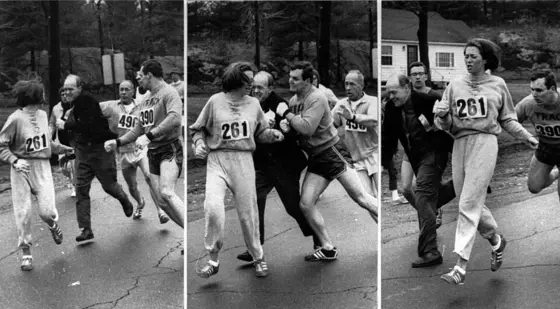
Around mile four, race official Jock Semple spotted Switzer from the press truck. He jumped out, sprinted toward her, grabbed the back of her sweatshirt, and tried to tear off her bib number. "Get the hell out of my race," he shouted. Photographs taken from the press truck captured three frames: Semple lunging at Switzer, her boyfriend Tom Miller delivering a shoulder block that sent Semple sprawling, and Switzer continuing forward with an expression of absolute determination.
Switzer finished the 26.2-mile course in approximately 4 hours and 20 minutes. She was disqualified after the race, and the AAU suspended her membership. The photographs went around the world. Within five years, the Boston Marathon officially opened to women.
The Year Before: Bobbi Gibb Runs Without a Number
The complete history of women at the Boston Marathon begins one year before Switzer's run. In 1966, Roberta "Bobbi" Gibb applied to enter the Boston Marathon as an official competitor and received a rejection letter from race director Will Cloney stating that women were "not physiologically capable" of running 26 miles. Gibb, who had trained extensively and run distances well beyond the marathon in preparation, treated the letter as incorrect rather than final.
Gibb traveled to Boston, hid in forsythia bushes near the start line wearing her brother's Bermuda shorts and a hooded sweatshirt, and joined the race after it began. She carried no bib number and received no official timing. She finished in approximately 3 hours and 21 minutes, ahead of roughly two-thirds of the male runners in the field.
The Boston Athletic Association did not acknowledge Gibb's 1966 finish in the official results. She ran the race again in 1967 and 1968, both times without an official number. The BAA eventually recognized all three of Gibb's finishes and now lists her as the first woman to complete the Boston Marathon course.
The Confrontation at Mile Four
Jock Semple was a Scottish-born marathon runner, physiotherapist, and the unofficial enforcer of Boston Marathon tradition. He had no documented animus toward women specifically; he routinely challenged anyone he considered an interloper or unofficial entrant. But his attempt to physically remove Switzer from the course created one of the most widely reproduced images in sports history.
The press truck photographs document three distinct moments: Semple grabbing Switzer's sweatshirt from behind, Tom Miller throwing a block that knocked Semple clear of the course, and Switzer running forward with her jaw set. The sequence appeared in newspapers across North America, Europe, and beyond. For many readers, those images became the visual shorthand for the entire argument about women in athletics.
Switzer's AAU disqualification after the race meant her 1967 finish carried no official standing. The race record listed her with "no time." The Amateur Athletic Union suspended her membership. Neither action stopped what had already started.
The Rules Changed: Women Enter Boston Officially in 1972
The physical confrontation between Semple and Switzer accelerated a shift already building inside women's distance running. Throughout the late 1960s, women were running marathons at performances that contradicted the medical and physiological arguments used to exclude them. Bobbi Gibb's 3:21 in 1966, run after training without institutional support, disproved the core premise that women's bodies could not sustain the marathon distance.
In 1972, the Boston Athletic Association officially opened the Boston Marathon to women. Nina Kuscsik became the first official women's champion that year, crossing the finish line in 3:10:26. The AAU also began sanctioning women's marathon events in 1972, the same year Boston changed its rules.
Twelve years after Boston opened its doors, the International Olympic Committee added the women's marathon to the Olympic program. At the 1984 Los Angeles Olympics, Joan Benoit Samuelson won the first women's Olympic marathon gold medal in 2:24:52. It had been 17 years since Jock Semple tried to pull Kathrine Switzer off the Hopkinton course.
Switzer After 1967: Runner, Broadcaster, Advocate
Switzer did not stop competing after her 1967 Boston run. She trained systematically and improved her marathon performance significantly over the following years. In 1974, she ran a 3:29:51 at the New York City Marathon. In 1975, she ran Boston in 2:51:37. That same year, she won the New York City Marathon outright.
Switzer became an Emmy Award-winning television sports commentator, covering marathon events for ABC Sports and other networks internationally. She used her public platform to campaign for the inclusion of the women's marathon in the Olympic Games, a goal achieved at the 1984 Los Angeles Games.
Switzer founded the 261 Fearless organization, a nonprofit that uses running as a vehicle for women's empowerment in communities around the world. The name derives directly from bib number 261, the number Jock Semple tried to tear from her in 1967. The number became the symbol of the movement.
In 2017, on the 50th anniversary of her original run, Switzer returned to Boston and ran the marathon again at age 70, finishing in 4:44:31. That year, the Boston Athletic Association permanently retired bib number 261 in her honor. No runner will ever again be assigned that number at Boston.
Frequently Asked Questions
Who was the first woman to run the Boston Marathon?
Bobbi Gibb ran the Boston Marathon course unofficially in 1966, finishing ahead of roughly two-thirds of the field. Kathrine Switzer was the first woman to run with an official bib number, in 1967. The Boston Athletic Association recognizes Gibb as the first woman to complete the course and Switzer as the first officially registered female entrant.
What happened to Kathrine Switzer during the 1967 Boston Marathon?
Race official Jock Semple jumped from a press truck at mile four and grabbed Switzer's sweatshirt, attempting to tear off bib number 261. Her boyfriend Tom Miller, a former All-American football player, threw a block that knocked Semple off the course. Switzer finished the race in approximately 4 hours 20 minutes. The photographs of the confrontation were published internationally.
When were women officially allowed to run the Boston Marathon?
1972. Nina Kuscsik was the first official women's champion, finishing in 3:10:26. The AAU also began sanctioning women's marathon events that same year.
Who was Bobbi Gibb?
Roberta "Bobbi" Gibb was the first woman to complete the Boston Marathon, running without an official bib number in 1966 after being told women were "not physiologically capable" of finishing the 26.2-mile race. She finished in about 3:21 after hiding near the start and joining the race after it began. The BAA now officially recognizes her three unofficial finishes (1966, 1967, 1968).
What was Kathrine Switzer's bib number?
261. The Boston Athletic Association permanently retired bib number 261 in 2017 on the 50th anniversary of Switzer's run. She ran the marathon that year at age 70, finishing in 4:44:31.
What AAU rule prevented women from running marathons?
The Amateur Athletic Union did not sanction women's races longer than 1.5 miles at the time of the 1967 Boston Marathon. The rule had no scientific basis. The AAU reversed course in 1972 and began sanctioning women's marathon events, the same year Boston officially admitted women as competitors.