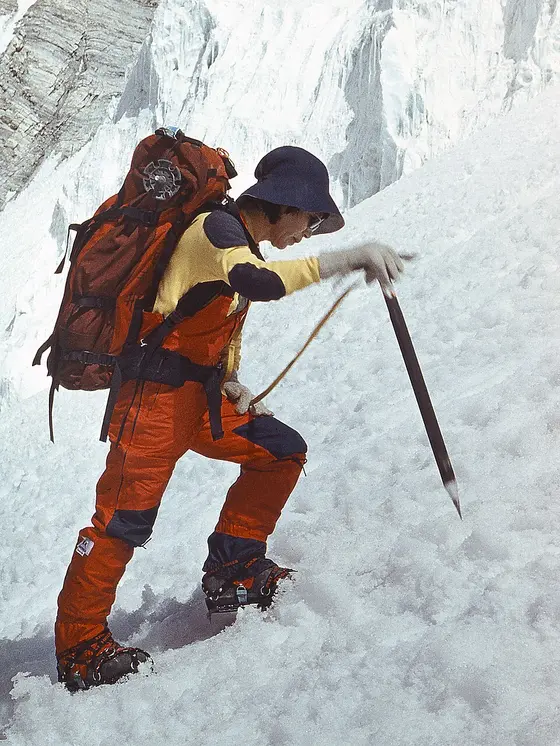
The Summit: May 16, 1975
On May 16, 1975, at 12:30 p.m. local time, Junko Tabei stood on the summit of Mount Everest at 29,032 feet (8,849 meters) above sea level. She was the first woman to reach the highest point on Earth. She was 35 years old, stood 4 feet 9 inches tall, and weighed about 92 pounds.
Twelve days earlier, an avalanche had buried her alive at Camp II on the South Col route. Sherpa guides dug her out after she had been unconscious for approximately six minutes. She could barely walk for two days afterward. She climbed to the summit anyway.
Tabei reached the top accompanied by Sherpa guide Ang Tsering. She spent about 15 minutes at the 8,849-meter peak before beginning the descent.
Childhood in Fukushima and the Birth of a Mountaineer
Tabei was born on September 22, 1939, in Miharu, a small town in Fukushima Prefecture, Japan. She was the fifth of seven children in a family of modest means. She was a small, sickly child who showed no early signs of becoming a high-altitude mountaineer.
Her relationship with mountain climbing began at age 10, when a teacher took her class on an excursion to Mount Nasu in Tochigi Prefecture. That single climb reshaped her sense of what was possible. She studied English literature at Showa Women's University in Tokyo and joined mountaineering clubs there, but encountered systematic resistance from male climbers who told women they did not belong on expeditions.
In 1969, Tabei co-founded the Ladies Climbing Club Japan with the explicit motto: "Let's go on an overseas expedition by ourselves." The club's founding principle was direct: if male-dominated climbing organizations excluded women, women would organize and climb independently.
The Japanese Women's Everest Expedition: 15 Climbers, One Goal
The 1975 Japanese Women's Everest Expedition assembled 15 Japanese women climbers and six Sherpa guides. The team approached Mount Everest from Nepal via the South Col route, the same corridor Edmund Hillary and Tenzing Norgay had used for the first ascent in 1953.
The South Col route ascends through the Khumbu Icefall, across the Western Cwm, up the Lhotse Face, and through the South Col at 7,906 meters before the final push to the summit. The team spent weeks establishing camps and acclimatizing to the reduced oxygen levels at extreme altitude.
On May 4, at approximately 6,300 meters, an avalanche struck Camp II in the night. Tabei and four teammates were buried under snow. The Sherpa guides, who occupied a separate tent, dug the women out. Tabei was unconscious and required revival. Multiple climbers sustained injuries.
Most high-altitude mountaineers would have treated the avalanche as a forced retreat. Tabei rested for two days and then resumed her ascent. On May 16, she and Ang Tsering reached the summit via the South Col. Phantog, a Tibetan climber, followed 11 days later to become the second woman on Everest.
The Seven Summits: First Woman to Complete Every Continent
After Everest, Tabei set a second historic goal: to climb the highest peak on every continent, completing what mountaineers call the Seven Summits.
She accomplished this over 17 years, summiting Kilimanjaro (Africa, 5,895 m, 1980), Aconcagua (South America, 6,961 m, 1987), Denali (North America, 6,190 m, 1988), Elbrus (Europe, 5,642 m, 1989), Vinson Massif (Antarctica, 4,892 m, 1991), and Puncak Jaya (Oceania, 4,884 m, 1992). In 1992, she became the first woman to complete the Seven Summits.
She continued climbing for the rest of her life. By the time she died, she had summited the highest peak in more than 70 countries across six continents.
Environmental Advocacy and Later Career
Tabei earned a graduate degree in environmental studies and became one of the most prominent advocates for sustainable mountaineering practices. She was troubled by the accumulation of waste on Everest and other heavily trafficked high-altitude routes. She worked to promote Leave No Trace principles within the mountaineering community and organized cleanup expeditions on popular peaks.
In 2012, doctors diagnosed her with peritoneal cancer. She continued climbing throughout treatment. In July 2016, three months before her death, she climbed a peak in Fukushima Prefecture as part of a project supporting recovery from the 2011 Tohoku earthquake and tsunami that had devastated the region of her birth.
Tabei died on October 20, 2016, in Kawagoe, Saitama, Japan, at age 77. The Junko Tabei Award, established posthumously by the Alpine Club of Canada, honors women who demonstrate exceptional contributions to mountaineering.
Frequently Asked Questions
Who was the first woman to climb Mount Everest?
Junko Tabei of Japan, on May 16, 1975, via the South Col route in Nepal, accompanied by Sherpa guide Ang Tsering.
How tall was Junko Tabei?
About 4 feet 9 inches (145 cm), weighing approximately 92 pounds at the time of the Everest climb.
Did Junko Tabei complete the Seven Summits?
Yes, in 1992, becoming the first woman to summit the highest peak on every continent.
What happened to Tabei's expedition on Everest?
An avalanche buried her at Camp II at 6,300 meters on May 4, 1975. Sherpa guides dug her out after about six minutes unconscious. Twelve days later, she reached the summit.
How many mountains did Junko Tabei climb?
She climbed the highest peak in more than 70 countries over her career, continuing into her seventies despite a peritoneal cancer diagnosis in 2012.