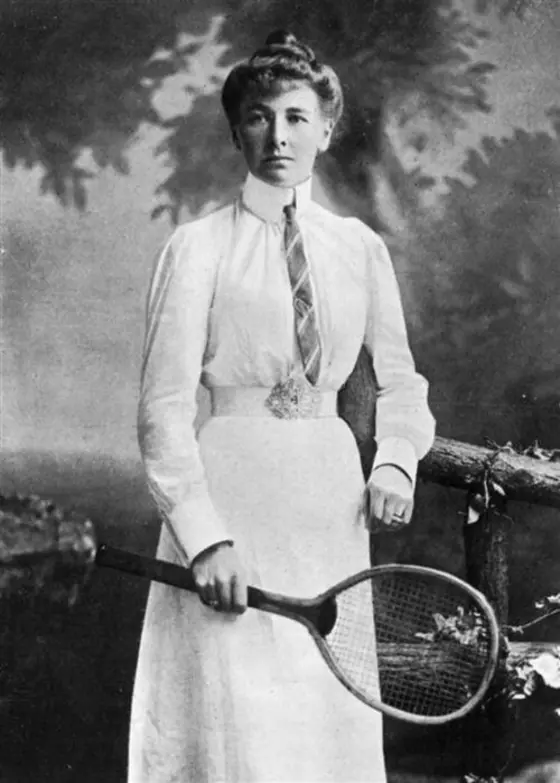
The Achievement
Charlotte Cooper defeated Hélène Prévost of France 6-1, 6-4 in the lawn tennis singles final at the 1900 Paris Olympics on July 11, 1900. That victory made Cooper the first woman to win an individual Olympic gold medal in the history of the modern Games. She was 29 years old, already a three-time Wimbledon champion, and competing with progressive hearing loss that most athletes of her era would have used as a reason not to compete at all.
The 1900 Paris Olympics were the second modern Games and the first to admit women. Twenty-two women entered out of approximately 997 total athletes. Female competitors were permitted in five sports: lawn tennis, sailing, croquet, equestrianism, and golf. Women's track and field, which would become the most visible measure of female athletic progress, would not appear in the Olympic program until 1928.
Cooper did not treat her Olympic gold medal as the peak of her career. She had already earned three Wimbledon singles titles before the Paris Games. She would add two more afterward. The Olympics were, for Charlotte Cooper, one tournament among many.
A Champion Before the Modern Olympics Existed
Charlotte Cooper was born on September 22, 1870, in Ealing, a suburb of West London in Middlesex, England. She began playing lawn tennis as a teenager and reached the top tier of British women's tennis within a decade. She won her first Wimbledon Ladies' Singles Championship in 1895, defeating Helen Jackson in the challenge round at the All England Lawn Tennis and Croquet Club in Wimbledon.
Cooper won the Wimbledon title again in 1896 and 1898, establishing herself as the dominant figure in late Victorian women's tennis. Her playing style distinguished her from contemporaries: she favored an aggressive serve-and-volley game and attacked the net, a tactical approach considered improper for women at a time when baseline rallying was viewed as the more feminine form of the sport.
She also competed while losing her hearing. Cooper began experiencing progressive hearing loss in her twenties, a condition that worsened throughout her competitive career. By the time she won her later Wimbledon titles, she was profoundly deaf. She could not hear the ball strike the strings of her opponent's racket, could not hear line calls, and could not hear crowd reactions. She relied entirely on sight and instinct refined through years of competitive match play.
The 1900 Paris Olympics: Women Enter the Games
The 1900 Paris Olympics were chaotic and unusual by modern standards. Organized as a sideshow to the Paris Exposition Universelle world's fair, the Games were spread across five months from May to October. Many athletes competing in Paris had no idea they were participating in the Olympic Games at all; their events were simply listed as fair competitions. There was no formal opening ceremony, no Olympic village, and no medals distributed at the time of competition. Winners received trophies and cups; the medals were mailed later.
The lawn tennis events took place on the courts of the Cercle de la Voile de Paris on the Île de Puteaux, an island in the Seine River near Paris. Cooper entered both the women's singles and the mixed doubles. She won gold in both, partnering with British tennis player Reginald Doherty in the mixed doubles final.
The question of who deserves credit as the first female Olympic champion requires a precise distinction. Hélène de Pourtalès of Switzerland sailed as part of a mixed crew that won the 1-2 ton sailing class on May 22, 1900, before the tennis events began. De Pourtalès is therefore the first woman to win an Olympic gold medal of any kind. Charlotte Cooper, winning the individual tennis singles title on July 11, is the first woman to win an Olympic gold medal in an individual event, unshared with male teammates.
Five Wimbledon Titles Across 13 Years
Charlotte Cooper's Wimbledon record spans 1895 to 1908: titles in 1895, 1896, 1898, 1901, and 1908. Her fifth and final championship title at age 37 made her the oldest women's singles champion in Wimbledon history at the time. The record stood until Martina Navratilova won at age 33 in 1990, though the scale and depth of competition between those eras was not comparable.
In 1901, Cooper married Alfred Sterry, a fellow lawn tennis competitor and later president of the Lawn Tennis Association. She competed under the name Mrs. Sterry from that point forward, which is how she appears in many historical records and contemporary newspaper accounts. Researchers tracing her career sometimes encounter the two names without realizing they refer to the same athlete.
Cooper retired from competitive tennis around 1912. She lived in Helensburgh, Scotland, for the remainder of her long life and died on October 10, 1966, at age 96, having outlived most of her competitive contemporaries by several decades.
Frequently Asked Questions
Who was the first woman to win an Olympic gold medal?
Charlotte Cooper of Great Britain won the lawn tennis singles at the 1900 Paris Olympics, making her the first woman to win an individual Olympic gold medal. Hélène de Pourtalès of Switzerland won a sailing gold medal earlier in those same Games, but as part of a mixed team.
When were women first allowed to compete in the Olympics?
At the 1900 Paris Olympics. The 1896 Athens Games were men-only. Twenty-two women competed in Paris across five sports: tennis, sailing, croquet, equestrianism, and golf.
How many Wimbledon titles did Charlotte Cooper win?
Five Wimbledon Ladies' Singles Championships: 1895, 1896, 1898, 1901, and 1908. She won her last title at age 37 while competing with profound hearing loss.
What was Charlotte Cooper's disability?
Charlotte Cooper developed progressive hearing loss in her twenties and was profoundly deaf by the later part of her competitive career. She could not hear line calls, the umpire's voice, or crowd noise, yet continued winning at the highest levels of women's tennis.
When did the Olympics reach gender parity?
The 2024 Paris Olympics was the first Games with equal numbers of male and female athletes, 124 years after Charlotte Cooper competed at the same city's Games in 1900.
Who was the first woman to compete in the Olympics?
Hélène de Pourtalès of Switzerland, who sailed in the 1-2 ton class on May 22, 1900, before the tennis events at those Games began.