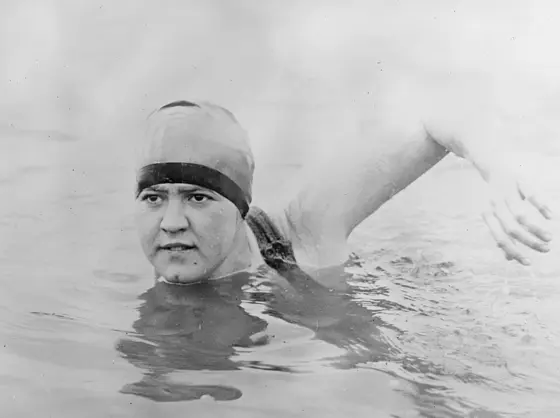
The Crossing: August 6, 1926
On August 6, 1926, Gertrude Ederle entered the water at Cap Gris-Nez, France, and swam toward England. Fourteen hours and 31 minutes later, she climbed ashore at Kingsdown, Kent. She was 19 years old. She had just become the first woman to swim the English Channel.
Ederle also beat the existing men's record by nearly two hours. The previous fastest crossing, by Argentine swimmer Enrique Tiraboschi in 1923, had taken 16 hours and 23 minutes. Before Ederle's crossing, only five men had completed the swim. She became the sixth person overall and the first woman.
The assumption that a woman could complete the 21-mile Dover Strait crossing at all was still widely doubted in 1926. That Ederle did it faster than any man had was not merely impressive. It directly disproved the prevailing belief in female athletic inferiority.
An Olympic Champion Before the Channel
Ederle was already one of the most decorated competitive swimmers in the world when she attempted the Channel crossing. Born on October 23, 1905, in New York City to German immigrant parents, she learned to swim in the Hudson River and Manhattan's public pools. As a teenager, she joined the Women's Swimming Association of New York, a pioneering organization that trained female competitive swimmers at a time when the sport largely excluded women.
By age 17, Ederle held 29 national and world swimming records in freestyle events. At the 1924 Paris Olympics, she won a gold medal in the 4x100-meter freestyle relay and two bronze medals in individual events. She was, by measurable result, among the fastest swimmers alive.
She first attempted the Channel crossing in 1925 but was pulled from the water after about nine hours when her trainer, Jabez Wolffe, believed she was in distress. Ederle maintained she had been resting. Under official Channel Swimming Association rules, any physical contact from a support boat disqualifies the swimmer. She disputed the pull and vowed to return.
What the Crossing Actually Required
Ederle entered the water at Cap Gris-Nez at 7:08 a.m. on August 6, 1926. Weather conditions were poor at the start and worsened through the day. Strong tidal currents in the Dover Strait pushed her southeast, away from her intended landing point at Dover. She ultimately came ashore at Kingsdown, approximately 14 miles south of Dover, because the tidal drift made a direct crossing impossible.
Her support boat carried her father, her sister Margaret, and her new trainer, Thomas Burgess, who had himself swum the Channel years earlier. When deteriorating conditions prompted Burgess to ask whether she wanted to stop, Ederle's response was three words: "What for?"
To cross the 21-mile strait, Ederle actually swam approximately 35 miles due to the tidal drift. She coated her body in lanolin and petroleum jelly to insulate against water temperatures in the low 60s Fahrenheit. She wore a two-piece bathing suit and motorcycle goggles sealed with paraffin wax to protect her eyes.
She reached Kingsdown at 9:39 p.m. A crowd had gathered on the beach. The men's record, previously considered a near-ceiling performance, had just been beaten by a teenager from New York.
The New York Homecoming
New York City honored Ederle with a ticker-tape parade on August 27, 1926. An estimated two million people lined the route through Lower Manhattan. The crowd exceeded the one that would greet aviator Charles Lindbergh a year later, after his solo transatlantic flight. President Calvin Coolidge publicly called her "America's best girl."
Ederle received vaudeville contracts, film offers, and endorsement deals. She starred in a short promotional film called "Swim Girl, Swim." For several months in late 1926, she was one of the most recognizable athletes in the United States.
After the Spotlight: Hearing Loss and the Lexington School
Fame did not last. Ederle suffered a nervous breakdown in 1928 and spent several years in recovery. Her hearing had deteriorated significantly, the result of years spent swimming in cold water. Prolonged exposure to cold water causes bony growths to form in the ear canal, a condition called exostosis (sometimes called surfer's ear), which can produce progressive hearing loss. Competitive swimmers of Ederle's era had no protection against it.
A back injury in 1933 left her in a cast for more than four years. Doctors told her she might never swim again.
She proved them wrong. After recovery, Ederle spent decades teaching deaf children to swim at the Lexington School for the Deaf in New York City. The school, founded in 1864, is one of the oldest programs for deaf education in the United States. Ederle taught swimming there from the 1940s through the 1960s, finding sustained purpose in the water long after competitive records and parades had faded.
She died on November 30, 2003, in Wyckoff, New Jersey, at age 98. In 2003, the International Swimming Hall of Fame named her one of the greatest female athletes of the twentieth century.
Frequently Asked Questions
Who was the first woman to swim the English Channel?
Gertrude Ederle, on August 6, 1926, swimming from Cap Gris-Nez, France, to Kingsdown, England, in 14 hours and 31 minutes.
How long did it take Gertrude Ederle to swim the English Channel?
14 hours and 31 minutes, beating the previous men's record of 16 hours 23 minutes by nearly two hours.
Who was the first person to swim the English Channel?
Captain Matthew Webb of England, on August 25, 1875, from Dover to Calais in approximately 21 hours 45 minutes.
Did Gertrude Ederle beat the men's record?
Yes, by nearly two hours. Enrique Tiraboschi had held the men's record at 16 hours 23 minutes since 1923.
What happened to Gertrude Ederle after her Channel swim?
She received a ticker-tape parade in New York City. She later lost much of her hearing from cold-water swimming (a condition called exostosis) and spent decades teaching deaf children to swim at the Lexington School for the Deaf. She lived to age 98.